Deodorizer Suppliers in Taiwan: An Industrial Odor Control Buying Guide
Introduction
Odor control is an important consideration for manufacturing facilities, wastewater treatment plants, livestock operations, food processing plants, and chemical production sites. Businesses need solutions that address workplace conditions, surrounding communities, and applicable environmental requirements.
Taiwan offers a range of deodorizing products and services, from household odor removers to industrial deodorizing agents and integrated air pollution control systems.
However, odor sources vary significantly across industries. Selecting a deodorizer requires more than comparing prices. Businesses should also consider the compounds responsible for the odor, operating conditions, application methods, and compatibility with existing treatment equipment.
This guide introduces selected deodorizer suppliers and brands in Taiwan, explains key purchasing considerations, and outlines how deodorizing agents can be incorporated into an industrial odor control strategy.
An Overview of Deodorizing Products and Services in Taiwan
Deodorizing products and services can generally be grouped into three categories:
- Household and commercial odor control products.
- Industrial deodorizing agents.
- Customized odor control systems and engineering services.
These categories serve different purposes. A product designed for indoor household odors should not automatically be considered suitable for industrial process exhaust.
Industrial applications require assessment of treatment performance, equipment compatibility, chemical consumption, maintenance requirements, and operating stability.
Depending on the contaminants and site conditions, a treatment system may combine exhaust collection, wet scrubbing, activated carbon adsorption, and suitable deodorizing agents. The appropriate combination should be determined through an application-specific assessment.
Selected Deodorizer Suppliers and Brands in Taiwan
The following overview includes companies and brands serving different markets. It is not a performance ranking, and their products should be evaluated according to the intended application.
SANREY — Industrial Odor Control and System Integration
SANREY provides industrial deodorizing agents and air pollution control equipment. Its service scope includes wet scrubbers, activated carbon adsorption equipment, exhaust collection planning, and maintenance support.
For industrial facilities, SANREY evaluates odor control needs in relation to the pollution source and operating conditions, helping customers assess both chemical treatment and equipment requirements.
Taiwan Amah — Household Cleaning and Consumer Products
Taiwan Amah offers household cleaning and related consumer products. Buyers should review individual product specifications to determine their suitability for the intended cleaning or odor management application.
Farcent’s Brand — Consumer Odor Control Products
Farcent offers consumer deodorizing and fragrance products under its brand. The product range includes options for indoor spaces and bathrooms.
These products serve different needs from engineered treatment systems for industrial exhaust.
Gojyo Taiwan — Microbial Deodorizing Products
Gojyo Taiwan offers microbial deodorizing products and supporting application information. Buyers should assess the intended odor source, application method, and operating conditions before selecting a product.
Yu Xiang Biotechnology — Cleaning Products and OEM/ODM Services
Yu Xiang Biotechnology offers cleaning products, selected deodorizing products, and OEM/ODM services.
For industrial applications, buyers should confirm the suitability of the specific formulation and request relevant product documentation.
How to Choose an Industrial Deodorizer
1. Identify the Odor Source
Start by identifying the process generating the odor and, where possible, the compounds involved.
Industrial odors may be associated with sulfur compounds, amines, or certain volatile organic compounds (VOCs). Each group can require a different treatment approach.
Useful information includes:
- The manufacturing process and raw materials involved.
- Odor characteristics and emission timing.
- Exhaust airflow, temperature, and humidity.
- Available odor or emissions measurement results.
A product suitable for one odor source may not perform equally well under different conditions.
2. Assess Compatibility with Existing Equipment
Determine whether the deodorizer will be used in a spray system, a wet scrubber, or another application.
Check its compatibility with equipment materials, dosing equipment, and operating conditions. Where applicable, also consider its effect on circulating water and wastewater management.
Chemical dosing should be planned as part of the treatment process.
3. Evaluate Performance under Representative Conditions
Odor reduction performance depends on the contaminants, concentration, contact time, dosage, and treatment method.
Ask suppliers for relevant application experience and available test information. Where practical, conduct a trial under conditions representative of the actual process.
A reduction in perceived odor should not be treated as proof of VOC removal.
4. Compare Total Operating and Maintenance Costs
The lowest purchase price does not necessarily deliver the lowest operating cost.
Consider:
- Product consumption and dilution requirements.
- Dosing equipment and energy use.
- Inspection and maintenance needs.
- Consumable replacement.
- Wastewater handling, where applicable.
A suitable solution should balance treatment needs with manageable long-term operating costs.
SANREY’s Industrial Deodorizing Solutions
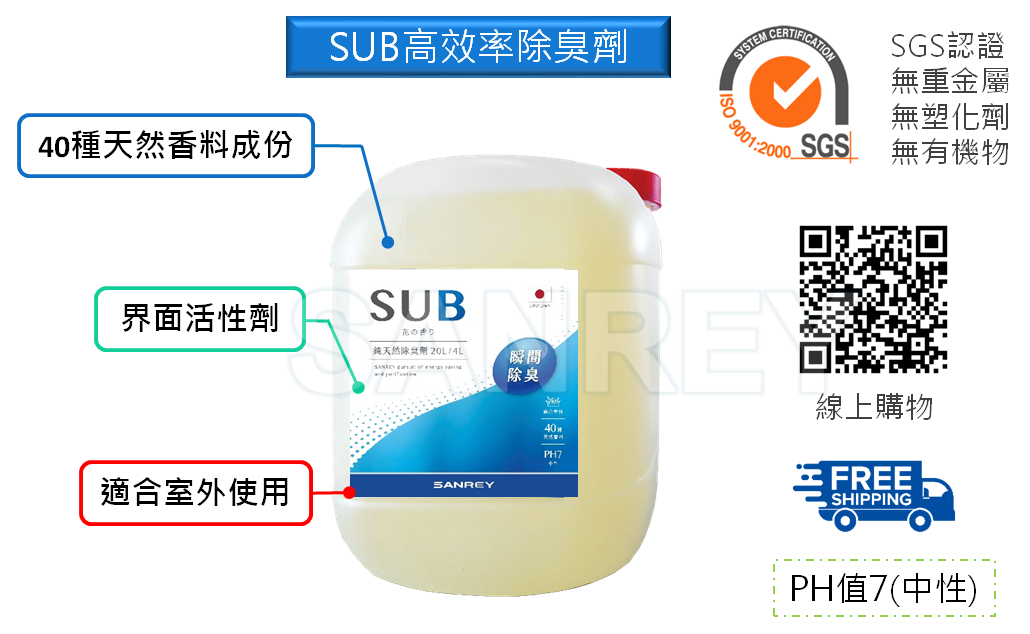
SUB Industrial Deodorizing Agent
SUB is part of SANREY’s industrial deodorizing product range.
For an application involving sulfur compounds, amines, or VOC-related odors, suitability should be assessed according to the actual contaminants, concentration, application method, and operating conditions.
Key assessment points include:
- The source and composition of the odor.
- The required dosing and contact conditions.
- Compatibility with existing treatment equipment.
- Product consumption and maintenance requirements.
- Results from site assessment or application trials.
For VOC-related applications, odor improvement and VOC emission reduction should be evaluated separately.
Why Industrial Odor Control May Require More Than a Deodorizer
Spraying a deodorizer may help manage certain odors. However, when a process continuously generates emissions, a more complete treatment approach may be required.
An industrial odor control system may include:
- Local exhaust ventilation to capture emissions near the source.
- Ductwork and collection systems to convey captured exhaust to treatment equipment.
- Wet scrubbers for contaminants suitable for absorption or chemical treatment.
- Activated carbon adsorption equipment for suitable gas-phase contaminants.
- Deodorizing agent dosing where appropriate for the application.
The treatment sequence should be selected according to the exhaust characteristics. Not every facility requires every treatment stage.
Effective source capture is also essential. Treatment equipment can only process the exhaust that is successfully collected and delivered to it.
SANREY’s Integrated Service Capabilities
SANREY provides services across Taiwan, with a main facility in Kaohsiung and offices in Taichung and Taoyuan.
Its service scope includes:
- Site assessment and customized planning.
- Wet scrubber design.
- Activated carbon adsorption equipment.
- Industrial deodorizing agent supply.
- Exhaust collection and local ventilation planning.
- Installation and maintenance support.
By considering the odor source, collection conditions, and treatment requirements together, SANREY helps businesses develop an integrated approach to industrial odor management.
Frequently Asked Questions
Q1: Do industrial deodorizers work?
Industrial deodorizers can help reduce certain odors when the formulation and application method are suitable for the target compounds.
Performance depends on the odor source, concentration, dosage, contact conditions, and operation. Some applications may also require exhaust collection and additional treatment equipment.
Q2: Can a deodorizer remove VOCs?
Some products may help reduce odors associated with certain VOCs. However, reducing odor does not necessarily mean that VOC emissions have been reduced.
Where VOC emission control is required, treatment should be selected for the specific compounds and operating conditions, with performance verified through appropriate measurements.
Q3: Does every wet scrubber need a deodorizer?
No. A wet scrubber’s treatment liquid and dosing requirements depend on the target contaminants and system design.
An additional deodorizing agent should be considered only when its suitability and compatibility have been assessed.
Q4: How should I choose an industrial deodorizer supplier?
Evaluate the supplier’s product documentation, relevant application experience, technical support, and after-sales service.
For industrial exhaust applications, also consider whether the supplier can assess source capture, treatment equipment, and chemical dosing as a coordinated system.
Three Key Takeaways from SANREY
1. Match the Supplier to the Application
Taiwan’s deodorizing market includes consumer products, industrial agents, and engineering services. Select suppliers according to the actual application and technical requirements.
2. Choose Treatment Based on the Contaminants
A stronger concentration alone does not establish suitability. Odor source identification, application conditions, and equipment compatibility are essential purchasing considerations.
3. Consider the Complete Treatment Process
Where appropriate, combining exhaust collection, wet scrubbing, activated carbon adsorption, and suitable chemical dosing can support a more complete odor control strategy.
SANREY’s Perspective
Industrial odor control should begin at the pollution source.
Deodorizing agents can be useful tools, but their role should be evaluated alongside source capture, exhaust characteristics, treatment equipment, and operating requirements.
SANREY provides planning, design, installation, and maintenance services to help industrial facilities develop odor control systems suited to their processes.
Discuss Your Industrial Odor Control Requirements
Looking for an industrial deodorizer supplier or an integrated odor control solution in Taiwan?
Contact SANREY with information about your process, odor source, exhaust airflow, and existing equipment. Our team can help assess suitable deodorizing agents and treatment configurations.
- Telephone: +886-7-763-3957
- Email: pauline@sanrey.com.tw
- Website: www.sanrey.com.tw
Welcome to contact with us and we will do our best to serve you anytime.